
The most economical mixing solution is not necessarily the largest one. When mixing time, discharge, cleaning, and material flow are aligned, a more compact mixing system may achieve the required hourly output while making integration into an existing production environment easier.
However, the optimal mixer size always depends on the product, batch concept, changeover frequency, and internal material logistics. For consistently large quantities of the same product, a larger mixer may still be the more economical choice.
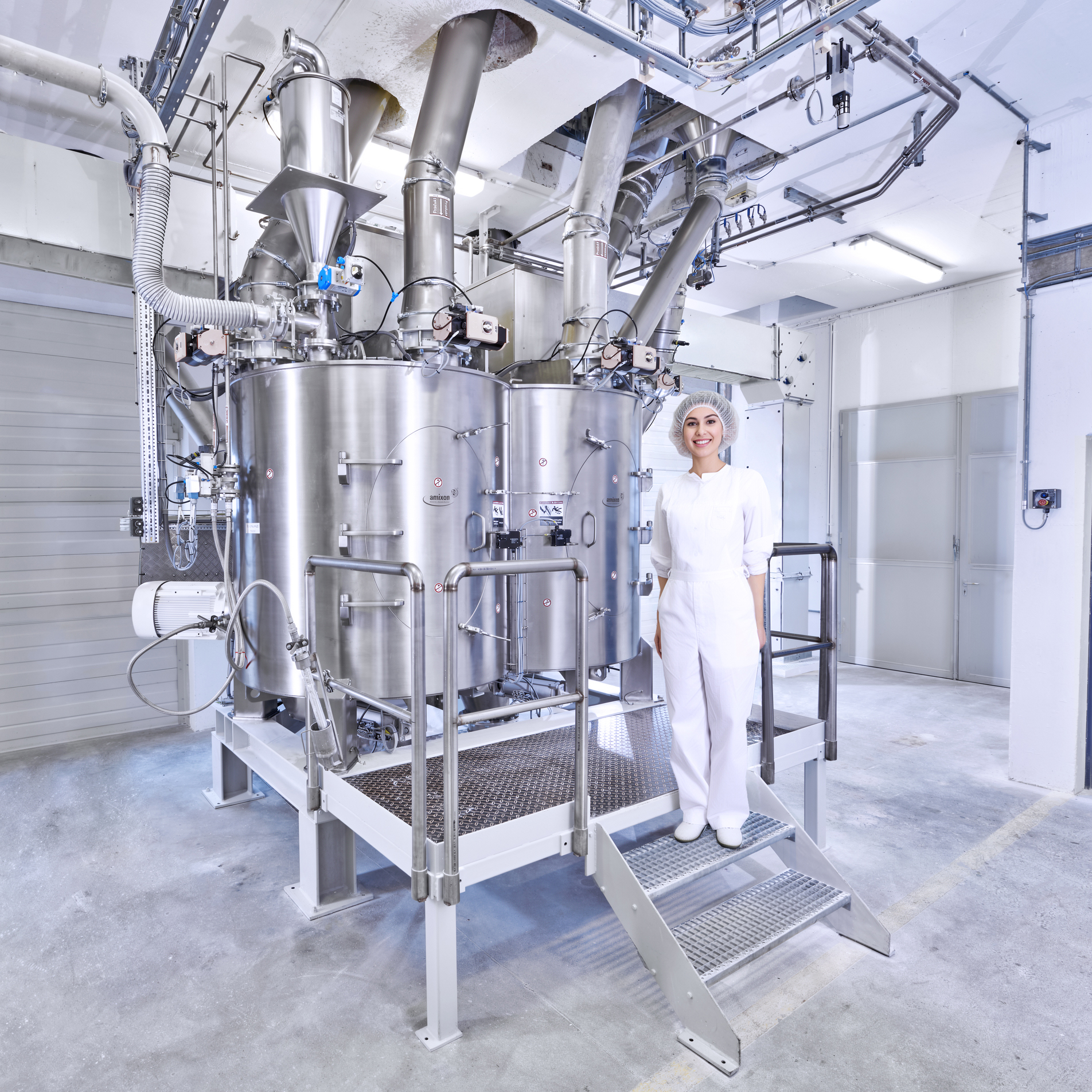

Actual plant output is determined by more than batch volume. Filling, mixing, discharge, and cleaning times also have a direct impact on throughput.
amixon® offers different mixing systems with mixing times that depend on the application. AM and VM single-shaft mixers typically achieve mixing times of around three to seven minutes, while HM twin-shaft mixers can achieve mixing times of approximately 0.25 to five minutes, depending on the mixing task.
Short mixing and cycle times can make it possible to use a smaller mixer volume. Whether this is economically advantageous must be assessed for the specific process, including raw material supply, dosing, discharge, and product changeovers.
For sensitive formulations, a short and gentle mixing process can help limit heat input. In addition to mixing time, the relevant factors include tool speed, fill level, product properties, and the overall process design.
In one amixon® application example for the final homogenization of dietary products, an HM 10,000 twin-shaft mixer operates at a tool tip speed of 1 m/s. According to amixon®, the products retain their low initial temperature under these conditions.
A more stable product temperature at the mixer outlet can reduce the need for downstream cooling or conditioning. The extent to which this is possible depends on the formulation and the required temperature range.
For dry and particularly hygroscopic powders, water is often undesirable in the production environment. Water or high humidity can negatively affect powder quality. This makes a product-appropriate dry, damp, or wet-cleaning strategy important.
A compact mixing vessel can improve manual access to product-contact surfaces. This requires sufficiently large inspection doors, a hygienic design, and geometry that supports the selected cleaning method. amixon® mixers can be designed with large inspection doors, good inspectability, and near-complete discharge for free-flowing products.
When upgrading an existing production facility, available floor space, access routes, and allowable floor or structural loads often become decisive constraints. A smaller and lighter mixing system can simplify installation and integration under these conditions.
Whether this also reduces structural modifications, steelwork, or peripheral equipment depends on the individual project. A robust system design should therefore consider not only mixing quality, but also available space, load capacity, filling, discharge, cleaning, and the required hourly output.
A smaller mixing system can be an effective solution when it delivers the required mixing quality and hourly output with short cycle times. Potential benefits include a smaller footprint, easier integration into existing facilities, improved manual accessibility, and—where the process is suitably designed—reduced heat input.
The actual benefits should be verified using the original product in mixing trials. Practical testing is essential for selecting and scaling the right mixing system.